
No vape club can operate in the United States without a working understanding of two overlapping federal regimes: the FDA's tobacco product regulations and the PACT Act as amended by the CONTRACE Act. Together, they define what may be sold, how it must be registered, and how it may be shipped.
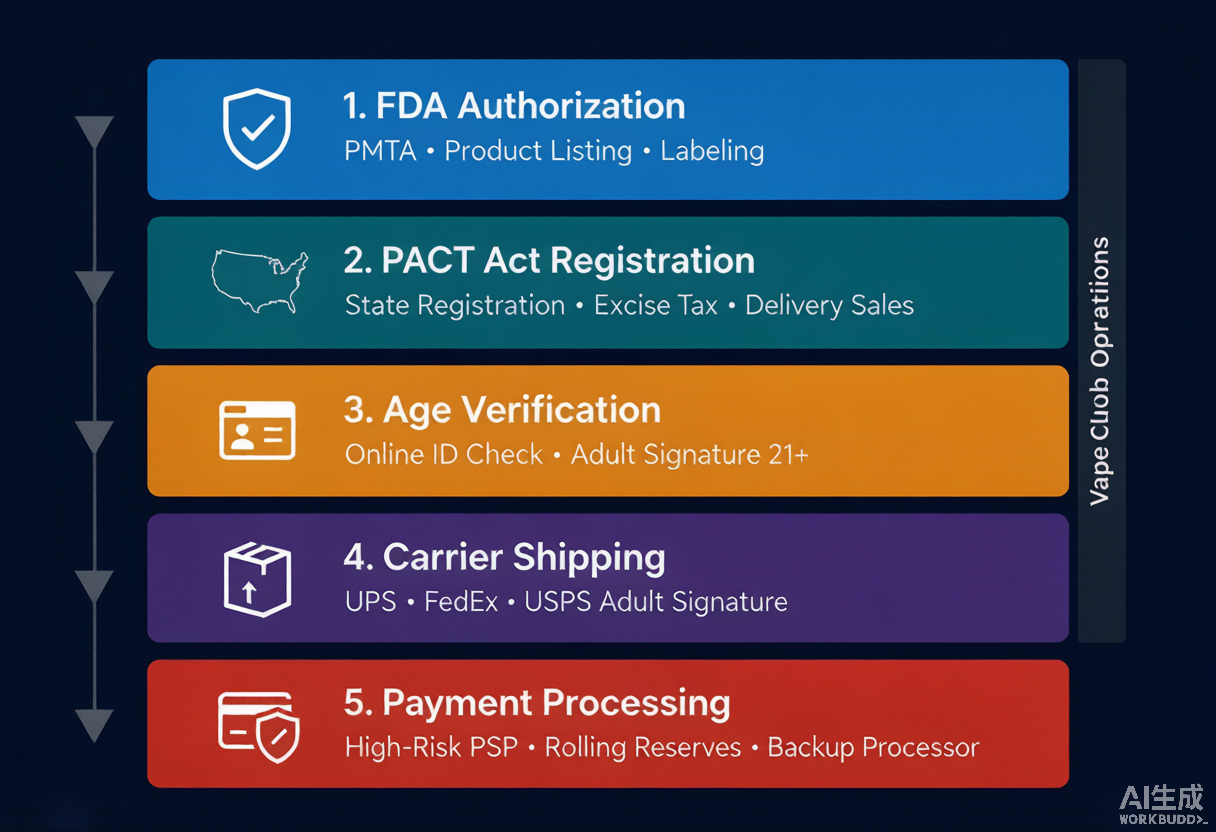
The diagram above maps the five compliance layers that every vape club must satisfy simultaneously. A weakness in any single layer — an unregistered state, an unauthorized SKU, a missing adult signature, a frozen merchant account — can halt the entire operation. The sections below address each layer in operational detail.
FDA Regulation of Vape Products
The U.S. Food and Drug Administration, through its Center for Tobacco Products (CTP), regulates all Electronic Nicotine Delivery Systems (ENDS) as tobacco products. For a vape club, the key FDA obligations are:
- Premarket authorization: Products must have a marketing authorization pathway — a Premarket Tobacco Product Application (PMTA) granted, or an exemption allowing continued marketing during review. Operators should confirm each SKU's authorization status before listing it in a membership tier.
- Product listing: Manufacturers and importers must submit product listings to FDA, including ingredients, HPHC (harmful and potentially harmful constituent) reporting, and labeling.
- Labeling and warning requirements: Product packaging and advertising must carry the required nicotine warning statement and comply with advertising restrictions targeting youth.
A vape club's compliance file should document each listed product's FDA status and retain the authorization record, so that the membership catalog reflects only legally marketable items.
PACT Act and Mail-Order Vape Sales
The Prevent All Cigarette Trafficking (PACT) Act, expanded by the CONTRACE Act effective 2021, classifies ENDS products as "cigarettes" under the statute's registration and reporting regime. The practical consequences for a vape club are significant:
- State registration: Vape sellers shipping into a state must register with that state's tobacco tax administrator under the PACT Act before making any delivery sale into the state.
- Excise tax reporting and remittance: Operators must file regular PACT Act reports with state tax authorities, disclosing sales volumes and remitting applicable excise taxes.
- Delivery sales restrictions: The Act imposes delivery sale requirements, including age verification at point of order and at delivery, and prohibits certain shipments via the U.S. Postal Service to non-compliant sellers.
Because vape club compliance obligations vary state by state, operators typically maintain a jurisdiction matrix tracking registration status, tax rates, and any state-specific delivery restrictions before accepting members in each state.
State-by-State Variation
Beyond federal law, states impose their own vape excise taxes, flavor restrictions, online sale bans, and licensing requirements. A compliant vape club must:
- Maintain a state eligibility map showing where it can lawfully enroll members and ship product.
- Apply state-specific excise tax collection at checkout for subscribed members.
- Restrict enrollment and shipping for states that prohibit remote vape sales entirely.
- Renew state registrations and licenses on each jurisdiction's cycle.